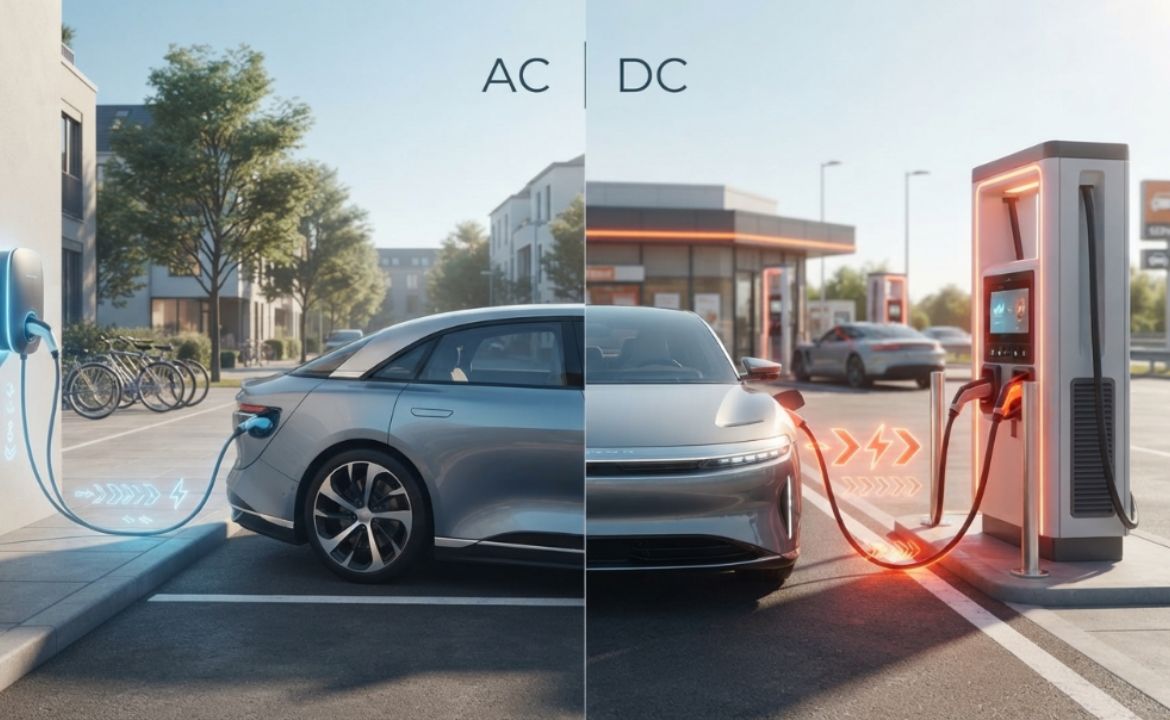
AC vs DC EV Charging Key Differences
Electric motors have become a common sight on roads everywhere, and with that shift comes a fair amount of confusion approximately how charging absolutely works. If you are new to the EV world, you have possibly stumble upon the terms “AC charging” and “DC charging” and wondered what sets them aside. Understanding AC vs DC EV charging is one of the first things every EV proprietor have to analyze, as it directly affects how rapid your car prices, where you may rate it, or even how a good deal it costs.
In this newsletter, we’ll damage down the differences among AC and DC EV charging in undeniable, easy language, so you can make smarter selections approximately charging your electric vehicle at domestic, at work, or on the road.
What Is AC Charging?
AC stands for Alternating Current, that is the type of strength that flows thru the strength grid and into your house. When you plug your EV right into a popular wall outlet or a home charging station, you’re using AC energy.
Here’s the seize: EV batteries can only save energy as Direct Current (DC). So while you operate AC charging, your vehicle’s onboard charger has to convert the AC power into DC before it could reach the battery. This conversion manner is one of the principal reasons AC charging tends to be slower than DC charging.
Common Uses of AC Charging
AC charging is normally used for:
- Home charging overnight
- Workplace charging at some stage in the day
- Public Level 2 chargers determined in parking lots, shops, and resorts
Because AC charging is slower, it’s first-class acceptable for conditions in which your vehicle might be parked for several hours.
What Is DC Charging?
DC stands for Direct Current, and this is the exact form of energy that EV batteries need. Unlike AC charging, DC charging skips the onboard converter completely. Instead, the conversion takes place inside the charging station itself, permitting power to flow at once into the battery.
This is why DC charging, regularly called DC speedy charging, is extensively faster than AC charging. In many instances, a DC speedy charger can take an EV battery from close to empty to 80% in as low as 20 to 40 minutes, relying on the automobile and charger ability.
Common Uses of DC Charging
DC charging is mainly discovered at:
- Highway rest stops
- Dedicated speedy-charging stations
- Urban charging hubs designed for short pinnacle-ups
If you’re on a road experience or need a quick fee at some point of a short smash, DC charging is the more realistic option.
AC vs DC EV Charging: The Core Differences
Now that we’ve blanketed the basics, let’s have a look at the direct assessment of AC vs DC EV charging across a few vital factors.
1. Charging Speed
This is the most sizeable distinction. AC charging is slower due to the conversion step going on within the automobile. DC charging is lots faster because it promises electricity at once to the battery without that extra step.
2. Equipment and Cost
AC chargers are normally extra low priced and simpler to put in, which is why they are commonplace in homes. DC chargers, on the other hand, require heavy-duty device and specialised infrastructure, making them greater highly-priced to install and preserve. This cost distinction is often pondered inside the rate you pay according to charging session at public stations.
3. Battery Impact
Frequent use of DC speedy charging can generate more warmth and stress on the battery through the years. Many producers advise the usage of AC charging for each day use and reserving DC speedy charging for occasional long journeys to assist preserve battery fitness.
four. Charger Availability
AC chargers are broadly available, from domestic retailers to public parking masses. DC chargers are much less common but growing step by step as EV adoption increases and charging networks extend.
5. Vehicle Compatibility
Not all EVs help the equal charging speeds. While most EVs can use AC charging, DC rapid charging aid depends on the car’s onboard hardware and battery layout. It’s always well worth checking your EV’s specifications before assuming it could take care of high-velocity DC charging.
Which One Should You Use?
The fact is, most EV owners come to be the use of both AC and DC charging depending on their situation. AC charging works outstanding for ordinary comfort, in particular in a single day at domestic when speed is not a concern. DC charging will become treasured whilst you’re short on time or riding long distances and want a short boost.
Understanding AC vs DC EV charging enables you intend smarter. For instance, relying best on DC rapid charging can be expensive and may upload pointless wear to your battery, even as using best AC charging may not be realistic for long avenue journeys.
A balanced technique, using AC for daily charging and DC for occasional speedy pinnacle-ups, is frequently the most green and value-effective strategy.
Final Thoughts
Choosing between AC and DC charging is not certainly approximately choosing one over the other; it’s about understanding whilst to apply each. AC charging offers comfort and affordability for day by day use, whilst DC charging promises pace whilst you need it maximum. Once you apprehend the difference between AC vs DC EV charging you may be in a position to plot your charging habits extra efficiently, guard your battery’s long-time period health, and make the maximum of your EV possession revel in.
As charging infrastructure keeps to enlarge, having a clean grasp of these two charging types will only become more beneficial, whether or not you are commuting every day or making plans your subsequent street trip.
FAQs
AC charging converts energy within the automobile and is slower, while DC charging can provide energy directly to the battery, making it an awful lot faster.
Occasional DC speedy charging is typically secure, but relying on it too frequently may also accelerate battery put on over the years.
It’s technically viable, but DC chargers are expensive and require specialized electrical infrastructure, so maximum house owners pick AC charging as a substitute.
AC charging can take numerous hours, at the same time as DC speedy charging can normally charge a battery to 80% inside 20 to forty minutes.
Not all EVs are geared up for DC rapid charging. It depends at the vehicle’s onboard hardware, so it is nice to test your vehicle’s specs.